Can a Old Landslide Become a Landslide Again
Home » Landslides » Landslide Hazard
Landslide Hazard Data
Landslides cause fatalities and billions of dollars in property damage each year.
Adapted from Usa Geological Survey Fact Sheet 2004-3072.
Landslide Incidence / Susceptibility Map
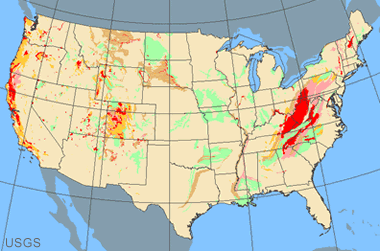
Landslide Map: This map shows the distribution of relative landslide incidence and susceptibility across the conterminous Us. Scarlet areas accept the highest rates of landslide incidence. Pink areas accept loftier rates of landslide incidence and susceptibility. Map by the United States Geological Survey. Enlarge Image.
Table of Contents
Landslides Occur in all 50 States
Landslides in the United states occur in all 50 States. Yet, three regions accept especially high rates of landslide incidence and susceptibility. They are:
- the coastal areas of California, Oregon, and Washington;
- the mountainous areas of Colorado, Idaho, Montana, Utah and Wyoming;
- the hilly to mountainous parts of Kentucky, N Carolina, Pennsylvania, Tennessee, Virginia, and West Virginia that are underlain by shale boulder.
Landslide Video: This USGS video explains some of the differences betwixt various types of landslides and describes some landslide science activities of USGS.
Landslide Impact and Mitigation
In the typical year, landslides in the United States cause billions of dollars in belongings harm and kill dozens of people. Casualties in the United States are primarily caused by rockfalls, rockslides, and debris flows. Worldwide, landslides cause thousands of casualties and result in many billions in budgetary losses each year.
The information presented here is an introduction to the landslide process, a presentation of the different types of landslides, and an introduction on how landslides can exist mitigated and managed as a hazard.
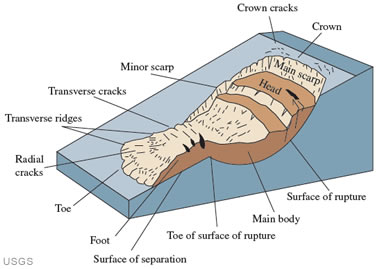
Landslide Beefcake: An idealized slump / earth period showing unremarkably used nomenclature for labeling the parts of a landslide. Enlarge image.
The Landslide Process
The term "landslide" describes a broad variety of processes that effect in the downward and outward move of gradient-forming materials including stone, soil, bogus fill, or a combination of these. The materials may move by falling, toppling, sliding, spreading, or flowing. The accompanying prototype is a graphic analogy of a landslide, with the commonly accustomed terminology describing its features.
Although landslides are primarily associated with mountainous regions, they can besides occur in areas of by and large low relief. In low-relief areas, landslides occur as cut-and-fill failures (roadway and building excavations), river bluff failures, lateral spreading landslides, collapse of mine-waste piles (especially coal), and a wide variety of slope failures associated with quarries and open-pit mines. The near common types of landslides are described and illustrated on this page.
Slides |
 |
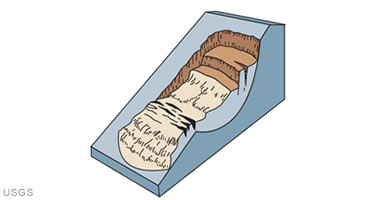
Rotational slide: This is a slide in which the surface of rupture is curved concavely upward, and the slide movement is roughly rotational about an centrality that is parallel to the ground surface and transverse across the slide.
Although many types of mass movements are included in the general term "landslide," the more restrictive use of the term refers merely to mass movements, where there is a distinct zone of weakness that separates the slide material from more stable underlying material. The two major types of slides are rotational slides and translational slides. Slide types and descriptions are illustrated on this page.
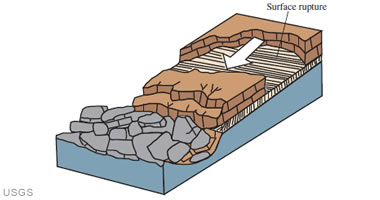
Block slide: A translational slide in which the moving mass consists of a single unit or a few closely related units that move downslope as a relatively coherent mass.
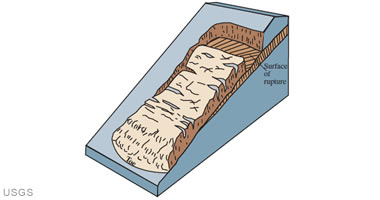
Translational slide: In this type of slide, the landslide mass moves along a roughly planar surface with fiddling rotation or astern tilting.
Falls |
| |
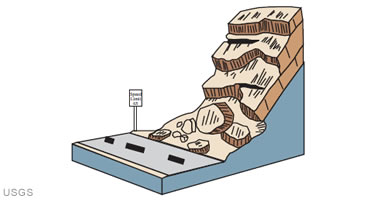
Rockfall: Falls are sharp movements of masses of geologic materials, such as rocks and boulders, that go detached from steep slopes or cliffs. Separation occurs forth discontinuities such as fractures, joints, and bedding planes, and movement occurs past free-fall, bouncing, and rolling. Falls are strongly influenced past gravity, mechanical weathering, and the presence of interstitial water.
A rockfall is a sudden fall or collapse of a large mass of cloth from a precipitous position. Rockfalls occur forth cliffs or very steep slopes where masses of rock can detach and begin a costless-fall, often combined with a bouncing or rolling descent. No slip-plane or surface of flow is involved.
Rockfalls are rapid, and because of their speed and sudden occurrence, they are very dangerous. They frequently occur in the spring equally freeze-thaw actions loosen jointed rocks.
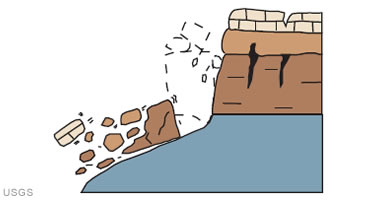
Topple: Toppling failures are distinguished by the forwards rotation of a unit or units about some pivotal signal, below or low in the unit, under the actions of gravity and forces exerted past adjacent units or by fluids in cracks.
Flows |
| |
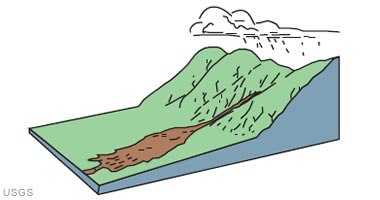
Debris flow: A droppings catamenia is a grade of rapid mass move in which a combination of loose soil, rock, organic affair, air, and water mobilize as a slurry that flows downslope. Debris flows include less than 50% fines. Debris flows are commonly caused by intense surface-h2o period, due to heavy precipitation or rapid snowmelt, that erodes and mobilizes loose soil or rock on steep slopes. Debris flows besides normally mobilize from other types of landslides that occur on steep slopes, are nearly saturated, and consist of a large proportion of silt- and sand-sized cloth. Droppings-flow source areas are often associated with steep gullies, and debris-flow deposits are usually indicated by the presence of debris fans at the mouths of gullies. Fires that denude slopes of vegetation intensify the susceptibility of slopes to debris flows.
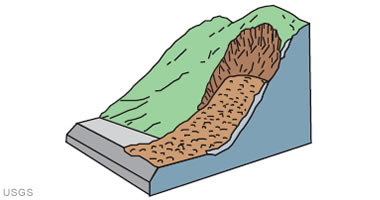
Debris avalanche: This is a variety of very rapid to extremely rapid droppings period.
At that place are 5 bones categories of flows that differ from one some other in central ways. Flow types and descriptions are illustrated on this page.
Although there are multiple types of causes of landslides, the three that cause most of the damaging landslides around the earth are (1) h2o; (2) seismic action; and (3) volcanic action. These are discussed in the sections below.
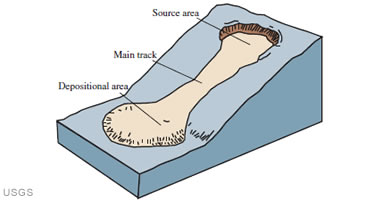
Earthflow: Earthflows have a feature "hourglass" shape. The slope fabric liquefies and runs out, forming a bowl or depression at the head. The period itself is elongate and usually occurs in fine-grained materials or clay-bearing rocks on moderate slopes and under saturated weather condition. Withal, dry flows of granular material are also possible.
Mudflow: A mudflow is an earthflow consisting of material that is wet enough to flow rapidly and that contains at least 50 percent sand-, silt-, and dirt-sized particles. In some instances, for example in many newspaper reports, mudflows and debris flows are commonly referred to every bit "mudslides."
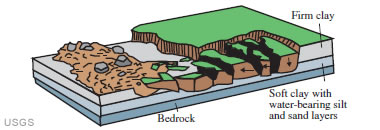
Lateral Spreads: Lateral spreads are distinctive considering they normally occur on very gentle slopes or apartment terrain. The dominant mode of motion is lateral extension accompanied by shear or tensile fractures. The failure is caused by liquefaction, the process whereby saturated, loose, cohesionless sediments (usually sands and silts) are transformed from a solid into a liquefied state. Failure is usually triggered by rapid ground movement, such every bit that experienced during an earthquake, but can also exist artificially induced. When coherent material, either bedrock or soil, rests on materials that liquefy, the upper units may undergo fracturing and extension and may and then subside, translate, rotate, disintegrate, or liquefy and menses. Lateral spreading in fine-grained materials on shallow slopes is usually progressive. The failure starts suddenly in a small-scale area and spreads rapidly. Often the initial failure is a slump, simply in some materials motility occurs for no apparent reason. Combination of two or more of the higher up types is known as a complex landslide.
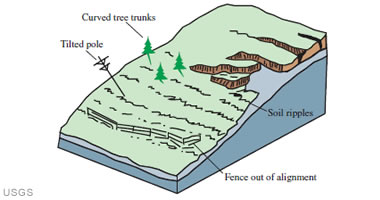
Pitter-patter: Creep is the imperceptibly slow, steady, downward motility of slope-forming soil or rock. Move is caused past shear stress sufficient to produce permanent deformation, simply as well modest to produce shear failure. There are mostly three types of creep: (1) seasonal, where motility is inside the depth of soil affected by seasonal changes in soil moisture and soil temperature; (2) continuous, where shear stress continuously exceeds the strength of the cloth; and (iii) progressive, where slopes are reaching the indicate of failure as other types of mass movements. Pitter-patter is indicated by curved tree trunks, bent fences or retaining walls, tilted poles or fences, and small soil ripples or ridges.
Causes of Landslides |
| |
Landslides and Water
Slope saturation by h2o is a master cause of landslides. This issue tin can occur in the course of intense rainfall, snowmelt, changes in groundwater levels, and water level changes forth coastlines, earth dams, and the banks of lakes, reservoirs, canals, and rivers.
Landsliding and flooding are closely allied considering both are related to precipitation, runoff, and the saturation of ground by water. In addition, droppings flows and mudflows usually occur in modest, steep stream channels and often are mistaken for floods; in fact, these two events often occur simultaneously in the aforementioned area.
Landslides can crusade flooding by forming landslide dams that block valleys and stream channels, allowing large amounts of water to back up. This causes backwater flooding and, if the dam fails, subsequent downstream flooding. Also, solid landslide debris can "bulk" or add volume and density to otherwise normal streamflow or cause aqueduct blockages and diversions, creating inundation conditions or localized erosion. Landslides can besides cause overtopping of reservoirs and/or reduced capacity of reservoirs to store water.
Advertizement
Landslides and Seismic Action
Many mountainous areas that are vulnerable to landslides have too experienced at to the lowest degree moderate rates of earthquake occurrence in recorded times. The occurrence of earthquakes in steep landslide-prone areas profoundly increases the likelihood that landslides will occur, due to basis shaking alone or shaking- caused dilation of soil materials, which allows rapid infiltration of water. The 1964 Slap-up Alaska Convulsion caused widespread landsliding and other footing failure, which caused about of the monetary loss due to the earthquake. Other areas of the The states, such equally California and the Puget Sound region in Washington, have experienced slides, lateral spreading, and other types of ground failure due to moderate to large earthquakes. Widespread rockfalls also are caused by loosening of rocks as a result of basis shaking. Worldwide, landslides acquired past earthquakes kill people and harm structures at higher rates than in the United States.
Landslides and Volcanic Action
Landslides due to volcanic activity are some of the about devastating types. Volcanic lava may melt snowfall at a rapid rate, causing a deluge of rock, soil, ash, and h2o that accelerates speedily on the steep slopes of volcanoes, devastating anything in its path. These volcanic debris flows (as well known equally lahars) reach great distances, one time they leave the flanks of the volcano, and tin can damage structures in flat areas surrounding the volcanoes. The 1980 eruption of Mount St. Helens in Washington triggered a massive landslide on the north flank of the volcano, the largest landslide in recorded times.
Geological Survey Contacts
Landslide Mitigation -
How to Reduce the Effects of Landslides
Vulnerability to landslide hazards is a part of location, type of homo activeness, utilise, and frequency of landslide events. The effects of landslides on people and structures can exist lessened by total avoidance of landslide adventure areas or by restricting, prohibiting, or imposing atmospheric condition on hazard-zone activity. Local governments can reduce landslide furnishings through land-use policies and regulations. Individuals can reduce their exposure to hazards past educating themselves on the past run a risk history of a site and by making inquiries to planning and applied science departments of local governments. They can likewise obtain the professional services of an engineering science geologist, a geotechnical engineer, or a civil engineer, who can properly evaluate the hazard potential of a site, built or unbuilt.
The risk from landslides can exist reduced past avoiding construction on steep slopes and existing landslides, or by stabilizing the slopes. Stability increases when groundwater is prevented from ascension in the landslide mass by (1) covering the landslide with an impermeable membrane, (ii) directing surface water away from the landslide, (3) draining groundwater away from the landslide, and (4) minimizing surface irrigation. Slope stability is too increased when a retaining structure and/ or the weight of a soil/stone berm are placed at the toe of the landslide or when mass is removed from the peak of the slope.
The original USGS fact sheet was compiled and designed by Lynn Highland and Margo Johnson.
Find Other Topics on Geology.com:
 Rocks: Galleries of igneous, sedimentary and metamorphic rock photos with descriptions. |  Minerals: Information about ore minerals, gem materials and rock-forming minerals. |
 Volcanoes: Articles about volcanoes, volcanic hazards and eruptions past and present. |  Gemstones: Colorful images and articles nearly diamonds and colored stones. |
 General Geology: Articles well-nigh geysers, maars, deltas, rifts, salt domes, water, and much more! |  Geology Store: Hammers, field bags, manus lenses, maps, books, hardness picks, aureate pans. |
 |  Diamonds: Learn nigh the backdrop of diamond, its many uses, and diamond discoveries. |
Source: https://geology.com/usgs/landslides/

Post a Comment for "Can a Old Landslide Become a Landslide Again"